If you need to replace a melt pressure transducer, the best place to start is usually the manufacturer and part number.
That's because a melt pressure transducer part number is often more than just a model number.
It's a specification sheet in disguise.
What Can a Part Number Tell You?
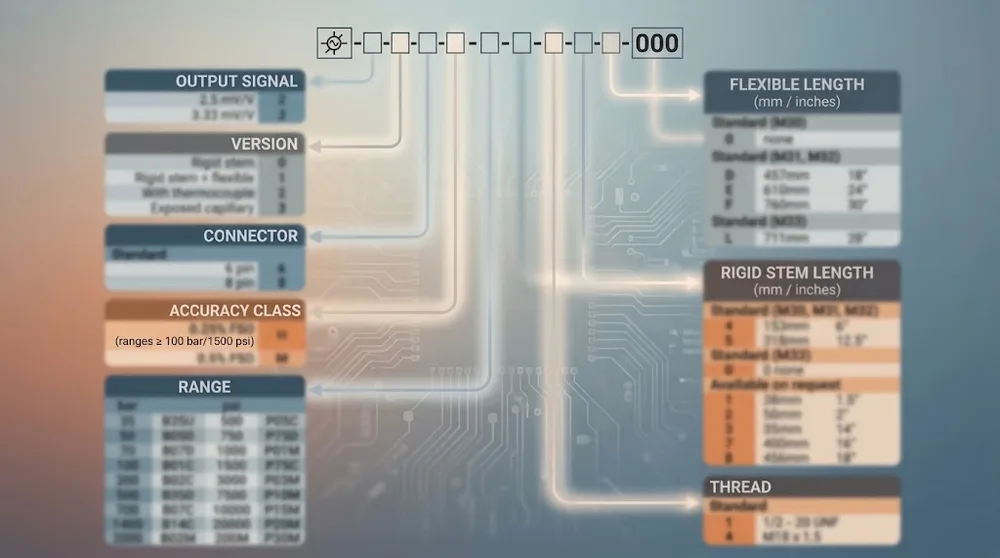
Manufacturers like Gefran, Dynisco and MPI use structured part numbers that can tell us quite a bit about the transducer.
Depending on the manufacturer, we can often determine things like:
-
Pressure range
-
Process connection
-
Rigid and flexible stem lengths
-
Output signal
-
Electrical connection
-
Temperature options
-
Other application-specific features
Here's an Example
GEFRAN | M31-6-M-P10M-1-4-D
DYNISCO | PT460E-10M-6/18
(Examples showing how the individual sections of a Gefran and Dynisco melt pressure transducer part number correspond to its specifications.)
Once those specifications are identified, we can determine what a compatible replacement needs to look like.
Cross-Referencing Is More Than Matching Pressure
Two melt pressure transducers can look almost identical and still not be interchangeable.
The pressure range may be correct, but the output signal could be different. The stem could be the wrong length. The connector or process thread might not match.
That's why we cross-reference the complete configuration, not simply the pressure range or physical appearance.
What If the Part Number Is Unreadable?
That's pretty common.
Years of heat, plastic, grease and maintenance aren't particularly kind to transducer labels.
Don't throw the old sensor away.
Take a few clear pictures of the sensor, including the label, connector and stem. Even a partial part number can give us useful information.
Let NNS Cross-Reference It
NoNonSensors maintains cross-reference information for many commonly used melt pressure transducers.
Have a Dynisco, Gefran, MPI or another manufacturer's sensor that needs replaced?
Send us the manufacturer and part number.
We'll help identify the correct replacement.
Can't read the number? Send ups pics below.
Make the next step a confident one.
Share your part number or process requirements. We’ll help you work through the fit.
Talk to an expert