
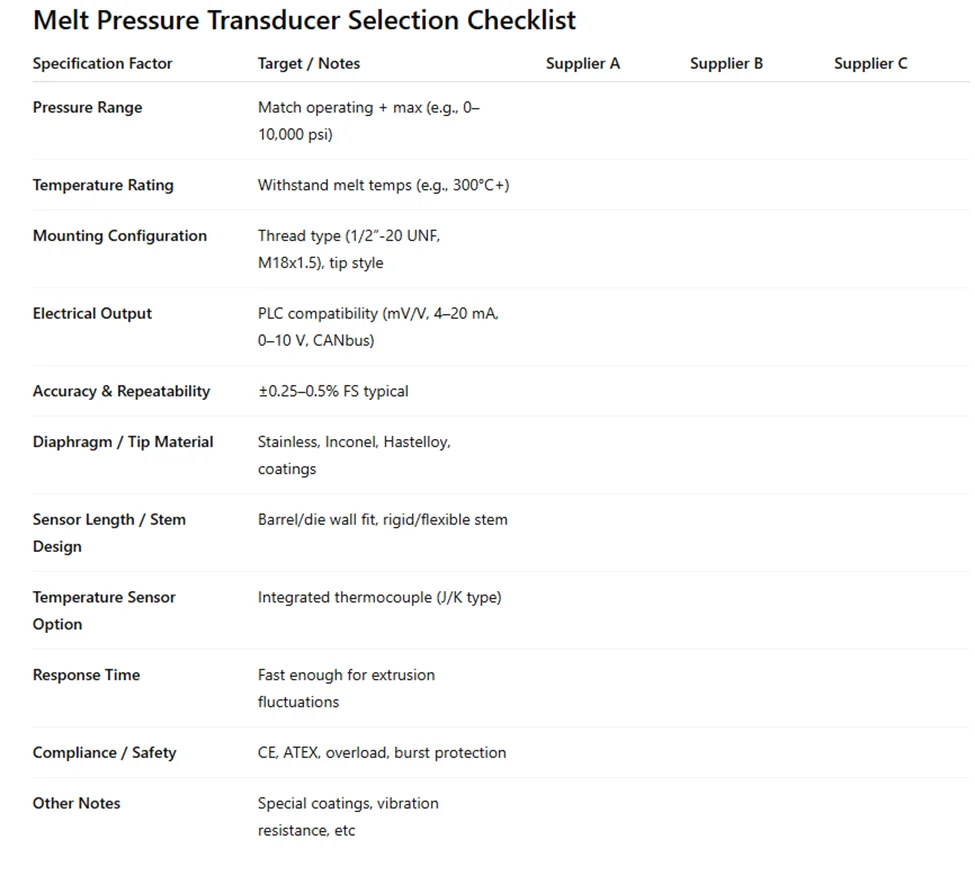
1. Pressure Range
-
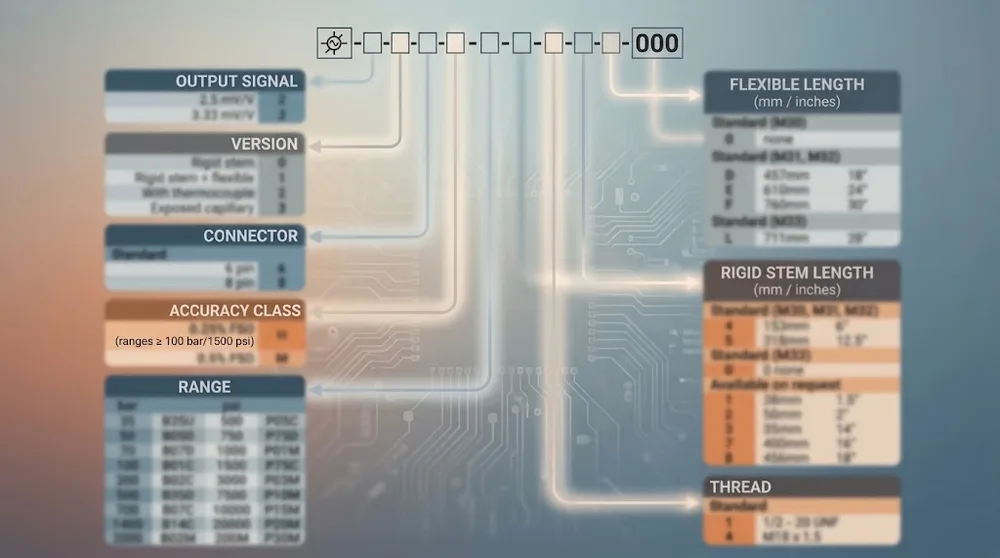
Must match the expected operating and maximum pressure in the extruder/die head.
-
Too low → risk of sensor overloading and failure.
-
Too high → poor resolution and less sensitive data.
-
Typical extrusion: 0–5,000 psi (345 bar) to 0–30,000 psi (2,000 bar).
2. Temperature Rating
-
The melt environment can exceed 300°C (570°F) depending on polymer type.
-
Sensor must withstand tip temperature and have adequate thermal isolation for electronics.
3. Mounting Configuration
-
Thread size and type (e.g., 1/2”-20 UNF standard, or M18 x 1.5 metric).
-
Tip style (standard melt bolt, extended stem, or special coatings for sticky polymers).
-
Proper fit avoids dead spots, cold spots, or material hang-up.
4. Electrical Output & Compatibility
-
Analog: mV/V, 4–20 mA, or 0–10 V.
-
Digital: CANbus, HART, or smart sensor interfaces.
-
Must match the plant’s PLC, control system, or monitoring software.
5. Accuracy & Repeatability
-
Look at combined error (non-linearity, hysteresis, repeatability), typically ±0.25%–0.5% full scale.
-
Important for process engineers who use melt pressure for material rheology calculations, not just machine alarms.
6. Diaphragm / Tip Material
- Stainless steel is common, but exotic alloys (Inconel, Hastelloy) or ceramic-coated tips are used for: - Abrasive fillers (glass fiber, talc, carbon). - Corrosive polymers (fluoropolymers, flame-retardant grades).
7. Sensor Length & Stem Design
-
Must fit extruder barrel thickness or die head wall.
-
Rigid stem, flexible stem, or armor cable for environments with vibration or limited space.
8. Temperature Sensor Integration
-
Many melt pressure transducers include a melt thermocouple (J/K/E type) or an RTD, in the same body.
-
Saves port space and provides simultaneous pressure + temperature data at the same location.
9. Response Time
-
Faster response transducers help capture pressure fluctuations during start-up, purge, or unstable runs.
-
Critical for high-speed extrusion or thin-wall products where stability matters.
10. Compliance & Safety
-
CE, ATEX, or other certification if used in hazardous environments.
-
Burst protection and overload limits for operator and equipment safety.
✅ Summary for process engineers: The key factors are pressure range, temperature rating, mounting/thread configuration, electrical output compatibility, and diaphragm material durability. Secondary but still critical are accuracy, response time, and whether a built-in thermocouple is needed.
Explore our NNS Custom Build Feature for basic sensors:
Make the next step a confident one.
Share your part number or process requirements. We’ll help you work through the fit.
Talk to an expert