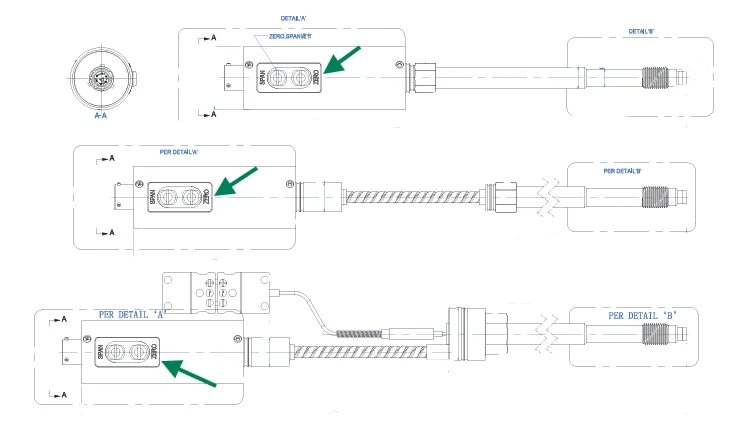


Although most of these are included in the separate product manuals that accompany quotes and production shipments, this provides a good overall view of standard specifications available.
Technical Specifications
Pressure Range:
-
Typical Range: Melt pressure transducers commonly operate within a pressure range of 0 to 10,000 psi (0 to 690 bar).
-
Extended Range: Some models are capable of measuring pressures up to 30,000 psi (2,068 bar) for specialized applications.
-
Accuracy:
-
Standard Accuracy: High-quality transducers often provide an accuracy of ±0.25% of full scale.
-
Enhanced Accuracy: Some advanced models offer even higher accuracy, up to ±0.1% of full scale.
-
Temperature Limits:
-
Operational Temperature Range: These transducers are typically designed to operate in high-temperature environments, with operational ranges often between -40°C and 400°C (-40°F to 752°F).
-
Temperature Stability: High-quality transducers include thermal compensation to maintain accuracy across this temperature range.
-
Output Types:
-
Analog Outputs: Common output signals include 4-20 mA, 0-10 V, and 0-5 V, which are widely compatible with many control systems.
-
Digital Outputs: Some transducers offer digital outputs such as RS232, RS485, or CAN bus for more advanced integration and data communication.
-
Electrical Specifications:
-
Power Supply: Typically, transducers require a power supply of 24 VDC, but some models may operate within a range of 12 to 36 VDC.
-
Electrical Connection: Industry-standard connectors such as M12, 6-pin, 8-pin and others ensure secure and reliable connections.
Compatibility with Various Equipment and Control Systems
-
Industry Standards:
-
Standardization: High-quality melt pressure transducers adhere to industry standards (e.g., ISO, ASTM), ensuring broad compatibility with various equipment and systems used in manufacturing and extrusion processes.
-
Control Systems:
-
PLC Integration: These transducers can easily integrate with programmable logic controllers (PLCs), which are commonly used in industrial automation systems.
-
SCADA Systems: Compatibility with Supervisory Control and Data Acquisition (SCADA) systems allows for remote monitoring and control, providing real-time data and analytics.
-
Data Acquisition Systems:
-
Analog and Digital Inputs: Transducers with both analog and digital outputs can interface with data acquisition systems, facilitating the collection and analysis of pressure data for quality control and process optimization.
-
Modular Connectivity: Modular connectivity options ensure that transducers can be easily connected to existing data acquisition systems without the need for extensive modifications.
-
Compatibility with Extrusion Equipment:
-
Extrusion Machines: These transducers are specifically designed to be compatible with various types of extrusion equipment, including plastic and food extruders, ensuring seamless integration.
-
Injection Molding Machines: Compatibility with injection molding machines allows for precise pressure control and monitoring during the molding process.
-
Interchangeability:
-
Standardized Mounting: Transducers often feature standardized mounting options (e.g., 1/2-20 UNF threads), making them easily interchangeable with other transducers and reducing downtime during maintenance or replacement.
-
Interchangeable Components: Some manufacturers offer interchangeable components, such as diaphragms and connectors, allowing for easy customization and replacement to suit specific applications.
-
Communication Protocols:
-
Fieldbus Integration: For more advanced control systems, some transducers support fieldbus communication protocols (e.g., Profibus, Modbus) for enhanced connectivity and integration.
-
Wireless Options: In certain models, wireless communication options are available, enabling remote monitoring and reducing the need for extensive cabling.
Make the next step a confident one.
Share your part number or process requirements. We’ll help you work through the fit.
Talk to an expert